The Opioid Crisis
What are prescription opioids?
Today’s healthcare providers are tasked to use evidence-based technologies to improve patient experience and clinical outcomes. Innovative technologies, such as tPEMF, can help clinicians improve
clinical outcomes and increase patient compliance while reducing costs.
SofPulse® tPEMF technology is supported by extensive clinical research to demonstrate that our products can address all of those needs.
How does SofPulse® help?
Treatment with SofPulse® allows you to better manage pain without the adverse side effects of narcotics and anti-inflammatory medication. SofPulse® reduces edema, the resulting pain level and thereby decreases the requirement for medication. With less pain and less medication, patients can move around sooner, which stimulates the body’s natural response to healing. SofPulse® tPEMF has been show to reduce pain, swelling and the need for prescription medications. Unlike prescription medications, SofPulse® has no known side effects.
Since SofPulse® does not contain any drugs, there is no risk of misuse or dependency.
Side Effects of Opioids
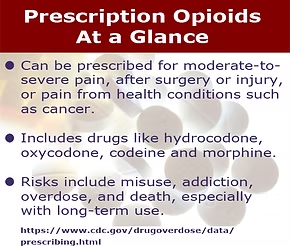 Like many medications, opioids can have unpleasant side effects (1,2,3) such as:
- Drowsiness
- Nausea
- Vomiting
- Cramping
- Constipation
- Itching\
- Breathing difficulty
- Hallucinations
Many of these side effects disappear with time or can be managed with dosage adjustments and additional medications as necessary.2
Opioid therapy is a short-term solution for moderate to severe pain; thus, the use of opioid medications should not exclude other possible longer term treatment options2.
Side effects of NSAIDS
- Stomach pain and heartburn
- Stomach ulcers
- A tendency to bleed more, especially when taking aspirin. Your doctor might tell you to stop taking NSAIDs before surgery. Ask your doctor before taking NSAIDs if you are on blood-thinning medications (such as Coumadin).
- Headaches and dizziness
- Ringing in the ears
- Allergic reactions such as rashes, wheezing, and throat swelling
- Liver or kidney problems. If you have any kidney problems, you shouldn’t take NSAIDs without checking with your doctor.
- High blood pressure
- Leg swelling
Opioids: By the Numbers
Opioid Drugs include both prescription and illicit drugs. Like heroin, opioid painkillers come from the poppy plant.
The majority of preventable drug overdose deaths (69%) involve opioids, totaling 37,814 in 2016
Preventable opioid overdose deaths increased 29% in 2016, and 544% since 1999
The opioid category that includes morphine, oxycodone and hydrocodone was involved in 12,101 deaths in 2016
The drug category most frequently involved in opioid overdoses and growing at the fastest pace is synthetic opioids other than methadone (fentanyl, fentanyl analogs and tramadol)
Fentanyl accounted for 17,696 preventable deaths in 2016, representing a 106% increase over the 8,609 total in 2015
Heroin accounted for the second highest number of deaths, claiming 14,606 lives in 2016, a 19% increase over the 12,284 deaths in 2015
How does the Opioid Crisis compare to others?
According to the National Safety Council, the over 63,632 people died from drug overdose in 2016; of those, over 42,000 deaths were from opioids (Hedegaard, Warner, & Miniño, 2017). How does that compare to other U.S. deaths?
47,000 American soldiers died in battle in the Vietnam War 1964–1975 (U.S. Department of Veterans Affairs, 2017)
351,602 Americans have died from opioid overdose since 1999 (National Center for Health Statistics, 2016)
291,000 American soldiers died in battle in World War II 1941–1945 (U.S. Department of Veterans Affairs, 2017)
50,000 Americans died from HIV in 1995, the peak year for HIV deaths: HIV was the number one cause of death for Americans age 25 to 44 (CDC, February 28, 1997)
6,700 Americans died from HIV in 2014 (Kochanek K. , Murphy, Xu, & Tejada-Vera, 2016)
Public education, treatment and prevention measures do work. For example, the spread of HIV has been dramatically curtailed, and deaths have decreased since its identification and public health response in the 1980s.
You can download the full National Safety Council’s report here.
References
American Academy of Family Physicians. (2008). Pain Control after surgery: Pain medicines. Patient education. MD Consult Web site, Core Collection. Retrieved from www.mdconsult.com.ezproxy2.library.arizona.edu/das/patient
Bajwa, Z.H.; Smith, H.S. (2011). Overview of the treatment of chronic pain. In: UpToDate, Basow, DS (Ed), UpToDate, Waltham, MA.
Tietze, K.J.. (2011). Pain control in the critically ill adult patient. In: UpToDate, Basow, DS (Ed), UpToDate, Waltham, MA.